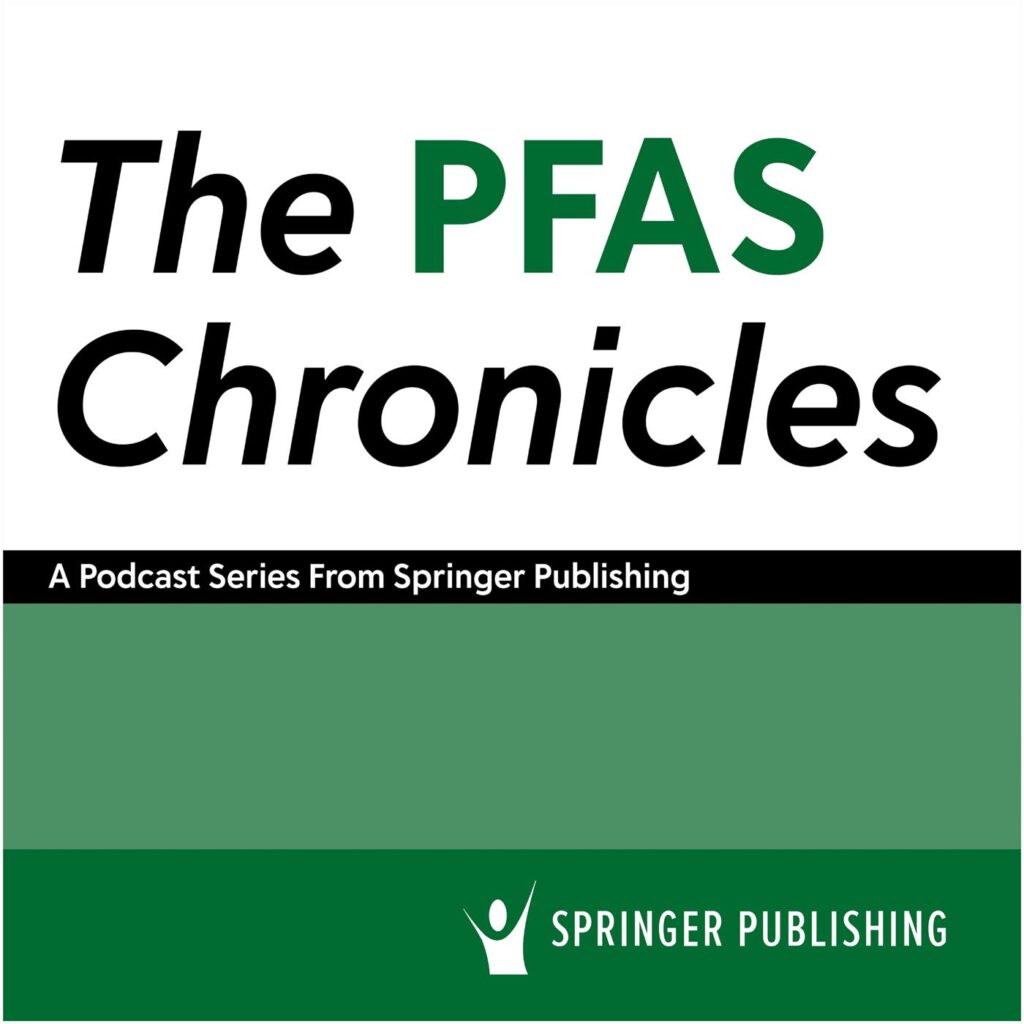
We are excited to unveil The PFAS Chronicles, a new five-episode podcast series from Springer Publishing created by hosts Anchal Malh and Natalie Conti, companion to the textbook Environmental Health: Foundations for Public Health. You can find the official landing page here.
Why PFAS? Why Now?
PFAS or per- and polyfluoroalkyl substances, sometimes called “forever chemicals,” have become a growing concern in environmental and public health circles. These synthetic chemicals resist breakdown and have been detected across water, soil, food, and even in human tissues. They raise questions about health risks, environmental justice, and what we as a society can do to respond.
With The PFAS Chronicles, our goal is to unpack the complex story behind PFAS: how they came to be, how they persist, and how communities and scientists are confronting them.
What to Expect in This Series
Over five episodes, listeners will join Anchal and Natalie as they guide conversations with leading researchers, advocates, and impacted community members. Each episode explores a facet of the PFAS story:
| Episode | Title / Focus | Guest(s) | What You’ll Learn |
| Episode 1 | The History of PFAS | Phil Brown (Northeastern University) | How PFAS entered industry and consumer products; the evolution of awareness and regulation |
| Episode 2 | The Science of PFAS Detection | Dr. Katherine Manz (Univ. of Michigan) | Analytical methods, contamination pathways, and how PFAS move through environment and the human body |
| Episode 3 | PFAS Where We Live, Work, and Play | Sandy Wynn-Stelt (Great Lakes PFAS Action Network) | Everyday exposure sources and risk mitigation strategies |
| Episode 4 | Firefighters & Forever Chemicals | Ayesha Khan & Jamie Honkawa (Nantucket PFAS Action Group) | Occupational risks of PFAS, especially for firefighting communities |
| Episode 5 | Halting the PFAS Cycle | Kristin Mello & Christopher Clark (WRAFT) | The limitations of current research, policies, and technology and how activism can shine a light on injustice |
Every episode offers accessible but rigorous discussions, bridging science, policy, and lived experience.
Who Are the Hosts?
- Anchal Malh, MS — With a background in natural history filmmaking and environmental health, she brings storytelling skills to complex scientific topics.
- Natalie Conti — A graduate student in Environmental Health Sciences (University of Michigan), she blends a scientific mindset with health communication and advocacy experience.
They aim to make PFAS science approachable and relevant — especially for public health professionals, students, policymakers, and interested citizens.
Why This Podcast Matters to Springer’s Community
At Springer Publishing, our mission is to foster knowledge that supports health and well-being. By producing The PFAS Chronicles, we extend that mission into the medium of audio. This podcast serves as a bridge between academic research, public policy, and community action — offering a resource for educators, practitioners, and decision makers who want to deepen their understanding.
Additionally, the podcast ties directly into Environmental Health: Foundations for Public Health; listeners can explore the topics further via the companion text, linking podcast insights to structured curricula and teaching resources. (The textbook is edited by Natalie Sampson, Lindsay Tallon, and Natasha DeJarnett.)
How to Listen & Share
The series is available via major platforms including Spotify, Apple Podcasts, and YouTube.