
What Is an LMSW?
An LMSW (Licensed Master Social Worker) is a social work professional who holds a master’s degree from a Council on Social Work Education (CSWE)-accredited program and has passed the Association of Social Work Boards (ASWB) Master’s-level licensing exam.
For many graduates, the LMSW is both a credential and a launching pad; the entry point into a rewarding career in social work. It qualifies you for a wide variety of positions while you decide whether independent clinical practice is the direction you want to go.
LMSWs work across many direct-service and community settings, including:
- hospitals
- schools
- community nonprofits
- government agencies
- social service organizations
- child protection agencies
- drug rehabilitation centers
Typical responsibilities include:
- case management
- client advocacy
- discharge planning
- supervised clinical work
- care coordination
- program coordination and development
- connecting clients to community resources
Many LMSW holders work in direct-service positions alongside other healthcare providers. They often provide therapeutic services such as individual counseling and group therapy. But in most states, this clinical work must be supervised by an LCSW, licensed psychologist, or other licensed clinician.
LMSW Requirements at a Glance
To become an LMSW, you typically must:
- Earn an MSW degree from a CSWE-accredited program.
NOTE: Most MSW degree programs include supervised field experience, also called field education, which provides the hands-on experience needed before applying for licensure. Some programs offer an Advanced Standing MSW track for candidates who already hold a bachelor’s degree in social work.
- Pass the ASWB Master’s exam
- Apply for licensure through your state social work board
| Requirement | Details |
|---|---|
| Education | Master’s in Social Work (MSW) from a CSWE-accredited program |
| Licensing Exam | ASWB Master’s Exam (170 questions, 4 hours) |
| Post-Grad Experience | Minimal or none required in most states |
| Supervision | Required for clinical/therapeutic work |
| Independent Practice | No. Clinical services must be supervised |
What Is an LCSW?
A Licensed Clinical Social Worker (LCSW) is a mental health professional who has completed additional post-graduate supervised clinical hours and passed the ASWB Clinical exam, earning an advanced clinical license.
In most states, LCSWs can:
- provide psychotherapy
- diagnose mental health conditions, including behavioral disorders
- open private practices
- supervise other social workers
- bill insurance for clinical services
Because of this clinical authority, the LCSW is often considered the highest level of licensure for clinical social work practice, granting full authority to practice independently.
LCSW Requirements at a Glance
| Requirement | Details |
|---|---|
| Education | Master’s in Social Work (MSW) from a CSWE-accredited program |
| Licensing Exam | ASWB Clinical Exam (170 questions, 4 hours) |
| Post-Grad Experience | 2,000–4,000 supervised clinical hours (most states require ~3,000) |
| Supervision | Must complete supervision under an LCSW or approved clinician |
| Independent Practice | Yes, can diagnose and treat independently |
LMSW vs. LCSW: Key Differences
The educational starting point is identical–both credentials require a CSWE-accredited MSW. The differences emerge after graduation.
| Factor | LMSW | LCSW |
|---|---|---|
| Education | CSWE-accredited MSW | CSWE-accredited MSW |
| Exam | ASWB Master’s Exam | ASWB Clinical Exam |
| Post-Grad Experience | Typically none required for licensure | 2,000–4,000 hours supervised clinical experience |
| Supervision | Required for clinical practice | Not required for independent practice |
| Can Diagnose? | Under supervision only | Yes, independently |
| Private Practice | Not independently | Yes |
| Salary Potential | Moderate | Higher due to clinical billing and private practice |
| Timeline | After MSW + Master’s exam | After supervised clinical experience (typically 2–4 years) |
Supervision and Independence
This is the defining distinction. An LMSW who wants to provide clinical services such as therapy, diagnosis, assessment-based treatment planning, must do so under the supervision of a licensed clinical professional. An LCSW can do all of this independently. If your long-term goal is to run your own practice or work as an autonomous clinician, the LCSW is the credential that gets you there.
Licensing Exams
Both exams are administered by the Association of Social Work Boards (ASWB) and share the same format: 170 scored questions over four hours. But the Clinical exam is more advanced. It places greater emphasis on diagnosis, treatment planning, clinical interventions, and ethical decision-making. The Master’s exam assesses generalized social work knowledge. The clinical exam tests whether you can independently manage a caseload.
If you’re preparing for the ASWB Master’s exam, targeted practice questions help you focus your study time where it matters most. See where you stand with Springer Publishing’s LMSW exam prep resources.
Post-Graduate Experience
Most states require LCSW candidates to complete between 2,000 and 4,000 hours of supervised clinical practice after earning their MSW. This typically takes between two to four years. These hours must involve direct client contact focused on assessment, therapy, and diagnostic evaluation. LMSW licensure, by contrast, requires little to no post-graduate experience in most states.
Scope of Practice
LMSWs can work in both clinical and non-clinical settings, but their clinical work must be supervised. They often gravitate toward case management, school social work, community-based services, program administration. LMSWs may focus on social welfare policy or addressing social problems at a systems level. LCSWs, on the other hand, have a broader clinical scope. This can include independent psychotherapy, clinical diagnosis, treatment planning, and the authority to accept insurance reimbursement for services.
How Much Do Social Workers Earn?
Clinical licensure often increases earning potential.
According to the U.S. Bureau of Labor Statistics, the median annual salary for social workers in the United States is approximately $58,000, though compensation varies widely by setting, specialization, and geography.
Licensed clinical social workers may earn more because they can:
- provide billable psychotherapy
- supervise clinicians
- operate private practices
- move into leadership roles
In private practice or specialized clinical settings, income potential can increase significantly. Source: U.S. Bureau of Labor Statistics, Occupational Outlook Handbook (Social Workers)
Which License is Better?
This isn’t really an either/or question–it’s a sequencing question. In many states, social workers first obtain a master’s-level license such as an LMSW, LSW, or LGSW before pursuing clinical licensure. The real decision is whether clinical licensure is the right next step for you.
The LMSW May Be Enough If…
You’re drawn to macro-level social work: policy, program management, advocacy, community organizing, or research. These roles carry real weight in the profession and don’t require clinical licensure to make a meaningful impact.
You want to work in schools, government agencies, or nonprofits in roles that don’t require independent clinical authority.
Some LMSWs build entire careers without pursuing the LCSW–and love what they do. For example, an LMSW working in a hospital case management role may never pursue clinical licensure. But an LMSW in a community mental health clinic will typically work toward the LCSW within a few years.
Pursue the LCSW If…
You want to provide psychotherapy independently.
You’re interested in private practice, clinical specialization, or working autonomously in a hospital or community mental health setting.
You want the salary ceiling and career flexibility that clinical licensure provides.
If you’re still unsure, begin accumulating supervised clinical hours in your current LMSW role. You can always continue the path, and those hours won’t go to waste.
Why Many LMSWs Eventually Pursue the LCSW
For many professionals, the LCSW unlocks additional long-term career flexibility.
An LCSW can:
- open a private therapy practice
- work independently without supervision
- expand career opportunities in healthcare and behavioral health
- increase earning potential
- supervise other clinicians
- transition into leadership roles
Many clinicians also value the greater autonomy and schedule control that comes with clinical licensure.
Transitioning from LMSW to LCSW
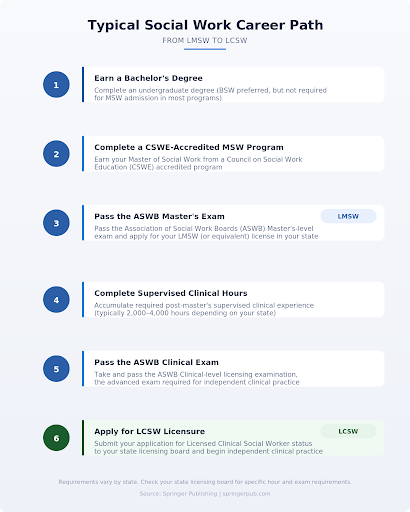
The path from LMSW to LCSW generally follows four steps:
- Accumulate supervised clinical hours.
- Complete your state’s supervision requirements.
- Pass the ASWB Clinical exam.
- Apply for licensure.
The process typically takes two to four years, though timelines and specific requirements vary by state. Once licensed, LCSWs must also meet continuing education and license renewal requirements to maintain their credential.
For a detailed breakdown of each step, common challenges, and a full state-by-state requirements table, see our complete guide: How to Transition from LMSW to LCSW: Steps, Challenges, and State-by-State Requirements
Frequently Asked Questions
What is the main difference between an LMSW and an LCSW?
The core difference is clinical independence. An LMSW can provide clinical services only under supervision, while an LCSW can diagnose and treat mental health conditions independently. Both require an MSW from a CSWE-accredited program, but the LCSW requires additional supervised clinical hours and passing the ASWB Clinical exam.
Can an LMSW practice therapy?
Yes, but not independently. In most states, an LMSW can provide therapeutic services under the supervision of a licensed LCSW, psychologist, or psychiatrist. The LMSW cannot independently diagnose mental health conditions or develop treatment plans without oversight. However, many LMSWs build practical experience in a clinically focused job while working toward the LCSW.
Can you become an LCSW without first becoming an LMSW?
In many states, social workers first obtain a master’s-level license such as an LMSW, LSW, or LGSW before pursuing clinical licensure. This allows them to practice while completing the supervised clinical experience required for the LCSW.
However, licensing rules vary by state, and some jurisdictions use different titles for the first post-MSW license. Always check your state social work licensing board for the exact requirements.
Is an LCSW a more advanced license than an LMSW?
Yes. In most states, the LCSW is considered a more advanced license than the LMSW.
An LMSW allows social workers to practice under supervision, while an LCSW allows independent clinical practice, including diagnosing mental health conditions, providing psychotherapy, and opening a private practice.
Because of these expanded responsibilities, earning an LCSW typically requires additional supervised clinical experience and a second licensing exam.
Can an LMSW diagnose mental illness?
In most states, an LMSW cannot diagnose mental health conditions independently. Diagnosis and independent clinical decision-making typically require an LCSW or equivalent clinical license.
However, LMSWs may participate in clinical work under the supervision of a licensed clinician, depending on state regulations and workplace policies.
Can an LMSW open a private practice?
Generally, no. Independent private practice usually requires an LCSW or equivalent clinical license.
An LMSW may provide clinical services within an organization or under supervision, but opening and operating a private therapy practice typically requires the clinical authority granted by an LCSW.
How long does it take to go from LMSW to LCSW?
Typically, two to four years. The timeline depends on your state’s supervised clinical hour requirements (which range from 1,500 to 4,000 hours), whether you’re working full-time in a clinical role, and supervisor availability. Full-time clinical positions can expedite the process.
What’s the difference between the ASWB Master’s and Clinical exams?
Both exams have 170 questions and a four-hour time limit, but the Clinical exam places greater emphasis on diagnosis, treatment planning, and clinical decision-making. The Master’s exam tests generalized social work knowledge; the Clinical exam evaluates readiness for independent clinical practice. Some states also recognize the ASWB Advanced Generalist exam, which covers both clinical and macro practice competencies.
TIP: Whether you’re sitting for the Master’s or Clinical exam, free practice questions are the fastest way to see what you’re up against. Explore LMSW and LCSW exam prep tools.
Do employers prefer LMSW or LCSW?
It depends on the role. Many entry-level social work positions accept or require an LMSW or equivalent master’s-level license. Clinical roles–especially those involving psychotherapy, diagnosis, or supervision–often require an LCSW.
Because the LCSW allows independent clinical practice, it may open additional career opportunities and leadership positions in healthcare and behavioral health organizations.
Which license should you pursue first?
For most MSW graduates, the first step is obtaining a master’s-level license such as the LMSW after passing the ASWB Master’s exam. After gaining clinical experience and completing supervision hours, many social workers, whether in human services, healthcare, or community-based roles, choose to pursue the LCSW to expand their career possibilities and scope of practice.
LMSW vs LCSW Salary: Do LCSWs Earn More?
Often, yes. Clinical licensure can increase earning potential because LCSWs may provide billable psychotherapy, supervise clinicians, and in many settings practice more independently. But salary varies widely by geography, setting, specialty, and years of experience. According to the U.S. Bureau of Labor Statistics, the median annual salary for social workers overall is approximately $58,000.
Making Your Decision
The LMSW and LCSW represent two stages on the same professional continuum. The LMSW is where most social workers begin — and for many, it’s exactly where they want to be. Whether you’re drawn to working alongside other healthcare providers or addressing social problems at the community level, both paths offer meaningful professional opportunities and long-term growth.
But if you see yourself providing psychotherapy, running your own practice, or working at the top of your clinical scope, the LCSW is the credential that opens those doors.
Whichever path you choose, invest in the foundation that gets you there. Start with free practice questions and find your path forward with Springer Publishing’s LMSW and LCSW exam prep.
work exam p is built by the clinicians and educator
The two most common licenses new social workers encounter are the Licensed Master Social Worker (LMSW), or a similar master’s-level license such as LSW or LGSW, and the Licensed Clinical Social Worker (LCSW). At first glance, they can look like small variations on the same credential. In reality, they represent different stages of a social worker’s professional path.
If you’ve finished a Master of Social Work (MSW) program, you’ve probably realized the MSW degree itself is only part of the story. Social work runs on licensure, and licensure runs on acronyms. The credential you pursue next won’t just determine what comes after your name on LinkedIn. It will shape the kind of work you do, how much independence you have, and how your career unfolds over time.
This guide breaks down LMSW vs LCSW, including education, exams, supervision, salary, and scope of practice. It also gives you a state-by-state look at what it takes to move from one to the other. Whether you’re drawn to direct practice or policy work, understanding these two credentials is the first step toward choosing the right career path.
Preparing for the LMSW exam and not sure where you stand? Start with free LMSW and LCSW practice questions to gauge your readiness.
Already planning ahead for licensure exams? Explore Springer Publishing’s full LMSW and LCSW exam prep resources.
What Is an LMSW?
An LMSW (Licensed Master Social Worker) is a social work professional who holds a master’s degree from a Council on Social Work Education (CSWE)-accredited program and has passed the Association of Social Work Boards (ASWB) Master’s-level licensing exam.
For many graduates, the LMSW is both a credential and a launching pad; the entry point into a rewarding career in social work. It qualifies you for a wide variety of positions while you decide whether independent clinical practice is the direction you want to go.
LMSWs work across many direct-service and community settings, including:
- hospitals
- schools
- community nonprofits
- government agencies
- social service organizations
- child protection agencies
- drug rehabilitation centers
Typical responsibilities include:
- case management
- client advocacy
- discharge planning
- supervised clinical work
- care coordination
- program coordination and development
- connecting clients to community resources
Many LMSW holders work in direct-service positions alongside other healthcare providers. They often provide therapeutic services such as individual counseling and group therapy. But in most states, this clinical work must be supervised by an LCSW, licensed psychologist, or other licensed clinician.
LMSW Requirements at a Glance
To become an LMSW, you typically must:
- Earn an MSW degree from a CSWE-accredited program.
NOTE: Most MSW degree programs include supervised field experience, also called field education, which provides the hands-on experience needed before applying for licensure. Some programs offer an Advanced Standing MSW track for candidates who already hold a bachelor’s degree in social work.
- Pass the ASWB Master’s exam
- Apply for licensure through your state social work board
| Requirement | Details |
| Education | Master’s in Social Work (MSW) from a CSWE-accredited program |
| Licensing Exam | ASWB Master’s Exam (170 questions, 4 hours) |
| Post-Grad Experience | Minimal or none required in most states |
| Supervision | Required for clinical/therapeutic work |
| Independent Practice | No. Clinical services must be supervised |
What Is an LCSW?
A Licensed Clinical Social Worker (LCSW) is a mental health professional who has completed additional post-graduate supervised clinical hours and passed the ASWB Clinical exam, earning an advanced clinical license.
In most states, LCSWs can:
- provide psychotherapy
- diagnose mental health conditions, including behavioral disorders
- open private practices
- supervise other social workers
- bill insurance for clinical services
Because of this clinical authority, the LCSW is often considered the highest level of licensure for clinical social work practice, granting full authority to practice independently.
LCSW Requirements at a Glance
| Requirement | Details |
| Education | Master’s in Social Work (MSW) from a CSWE-accredited program |
| Licensing Exam | ASWB Clinical Exam (170 questions, 4 hours) |
| Post-Grad Experience | 2,000–4,000 supervised clinical hours (most states require ~3,000) |
| Supervision | Must complete supervision under an LCSW or approved clinician |
| Independent Practice | Yes, can diagnose and treat independently |
LMSW vs. LCSW: Key Differences
The educational starting point is identical–both credentials require a CSWE-accredited MSW. The differences emerge after graduation.
| Factor | LMSW | LCSW |
| Education | CSWE-accredited MSW | CSWE-accredited MSW |
| Exam | ASWB Master’s Exam | ASWB Clinical Exam |
| Post-Grad Experience | Typically none required for licensure | 2,000–4,000 hours supervised clinical experience |
| Supervision | Required for clinical practice | Not required for independent practice |
| Can Diagnose? | Under supervision only | Yes, independently |
| Private Practice | Not independently | Yes |
| Salary Potential | Moderate | Higher due to clinical billing and private practice |
| Timeline | After MSW + Master’s exam | After supervised clinical experience (typically 2–4 years) |
Supervision and Independence
This is the defining distinction. An LMSW who wants to provide clinical services such as therapy, diagnosis, assessment-based treatment planning, must do so under the supervision of a licensed clinical professional. An LCSW can do all of this independently. If your long-term goal is to run your own practice or work as an autonomous clinician, the LCSW is the credential that gets you there.
Licensing Exams
Both exams are administered by the Association of Social Work Boards (ASWB) and share the same format: 170 scored questions over four hours. But the Clinical exam is more advanced. It places greater emphasis on diagnosis, treatment planning, clinical interventions, and ethical decision-making. The Master’s exam assesses generalized social work knowledge. The clinical exam tests whether you can independently manage a caseload.
If you’re preparing for the ASWB Master’s exam, targeted practice questions help you focus your study time where it matters most. See where you stand with Springer Publishing’s LMSW exam prep resources.
Post-Graduate Experience
Most states require LCSW candidates to complete between 2,000 and 4,000 hours of supervised clinical practice after earning their MSW. This typically takes between two to four years. These hours must involve direct client contact focused on assessment, therapy, and diagnostic evaluation. LMSW licensure, by contrast, requires little to no post-graduate experience in most states.
Scope of Practice
LMSWs can work in both clinical and non-clinical settings, but their clinical work must be supervised. They often gravitate toward case management, school social work, community-based services, program administration. LMSWs may focus on social welfare policy or addressing social problems at a systems level. LCSWs, on the other hand, have a broader clinical scope. This can include independent psychotherapy, clinical diagnosis, treatment planning, and the authority to accept insurance reimbursement for services.
How Much Do Social Workers Earn?
Clinical licensure often increases earning potential.
According to the U.S. Bureau of Labor Statistics, the median annual salary for social workers in the United States is approximately $58,000, though compensation varies widely by setting, specialization, and geography.
Licensed clinical social workers may earn more because they can:
- provide billable psychotherapy
- supervise clinicians
- operate private practices
- move into leadership roles
In private practice or specialized clinical settings, income potential can increase significantly. Source: U.S. Bureau of Labor Statistics, Occupational Outlook Handbook (Social Workers)
Which License is Better?
This isn’t really an either/or question–it’s a sequencing question. In many states, social workers first obtain a master’s-level license such as an LMSW, LSW, or LGSW before pursuing clinical licensure. The real decision is whether clinical licensure is the right next step for you.
The LMSW May Be Enough If…
- You’re drawn to macro-level social work: policy, program management, advocacy, community organizing, or research. These roles carry real weight in the profession and don’t require clinical licensure to make a meaningful impact.
- You want to work in schools, government agencies, or nonprofits in roles that don’t require independent clinical authority.
Some LMSWs build entire careers without pursuing the LCSW–and love what they do. For example, an LMSW working in a hospital case management role may never pursue clinical licensure. But an LMSW in a community mental health clinic will typically work toward the LCSW within a few years.
Pursue the LCSW If…
- You want to provide psychotherapy independently.
- You’re interested in private practice, clinical specialization, or working autonomously in a hospital or community mental health setting.
- You want the salary ceiling and career flexibility that clinical licensure provides.
If you’re still unsure, begin accumulating supervised clinical hours in your current LMSW role. You can always continue the path, and those hours won’t go to waste.
Why Many LMSWs Eventually Pursue the LCSW
For many professionals, the LCSW unlocks additional long-term career flexibility.
An LCSW can:
- open a private therapy practice
- work independently without supervision
- expand career opportunities in healthcare and behavioral health
- increase earning potential
- supervise other clinicians
- transition into leadership roles
Many clinicians also value the greater autonomy and schedule control that comes with clinical licensure.
Transitioning from LMSW to LCSW
The path from LMSW to LCSW generally follows four steps:
- Accumulate supervised clinical hours.
- Complete your state’s supervision requirements.
- Pass the ASWB Clinical exam.
- Apply for licensure.
The process typically takes two to four years, though timelines and specific requirements vary by state. Once licensed, LCSWs must also meet continuing education and license renewal requirements to maintain their credential.
For a detailed breakdown of each step, common challenges, and a full state-by-state requirements table, see our complete guide: [How to Transition from LMSW to LCSW: Steps, Challenges, and State-by-State Requirements]
Frequently Asked Questions
What is the main difference between an LMSW and an LCSW?
The core difference is clinical independence. An LMSW can provide clinical services only under supervision, while an LCSW can diagnose and treat mental health conditions independently. Both require an MSW from a CSWE-accredited program, but the LCSW requires additional supervised clinical hours and passing the ASWB Clinical exam.
Can an LMSW practice therapy?
Yes, but not independently. In most states, an LMSW can provide therapeutic services under the supervision of a licensed LCSW, psychologist, or psychiatrist. The LMSW cannot independently diagnose mental health conditions or develop treatment plans without oversight. However, many LMSWs build practical experience in a clinically focused job while working toward the LCSW.
Can you become an LCSW without first becoming an LMSW?
In many states, social workers first obtain a master’s-level license such as an LMSW, LSW, or LGSW before pursuing clinical licensure. This allows them to practice while completing the supervised clinical experience required for the LCSW.
However, licensing rules vary by state, and some jurisdictions use different titles for the first post-MSW license. Always check your state social work licensing board for the exact requirements.
Is an LCSW a more advanced license than an LMSW?
Yes. In most states, the LCSW is considered a more advanced license than the LMSW.
An LMSW allows social workers to practice under supervision, while an LCSW allows independent clinical practice, including diagnosing mental health conditions, providing psychotherapy, and opening a private practice.
Because of these expanded responsibilities, earning an LCSW typically requires additional supervised clinical experience and a second licensing exam.
Can an LMSW diagnose mental illness?
In most states, an LMSW cannot diagnose mental health conditions independently. Diagnosis and independent clinical decision-making typically require an LCSW or equivalent clinical license.
However, LMSWs may participate in clinical work under the supervision of a licensed clinician, depending on state regulations and workplace policies.
Can an LMSW open a private practice?
Generally, no. Independent private practice usually requires an LCSW or equivalent clinical license.
An LMSW may provide clinical services within an organization or under supervision, but opening and operating a private therapy practice typically requires the clinical authority granted by an LCSW.
How long does it take to go from LMSW to LCSW?
Typically, two to four years. The timeline depends on your state’s supervised clinical hour requirements (which range from 1,500 to 4,000 hours), whether you’re working full-time in a clinical role, and supervisor availability. Full-time clinical positions can expedite the process.
What’s the difference between the ASWB Master’s and Clinical exams?
Both exams have 170 questions and a four-hour time limit, but the Clinical exam places greater emphasis on diagnosis, treatment planning, and clinical decision-making. The Master’s exam tests generalized social work knowledge; the Clinical exam evaluates readiness for independent clinical practice. Some states also recognize the ASWB Advanced Generalist exam, which covers both clinical and macro practice competencies.
TIP: Whether you’re sitting for the Master’s or Clinical exam, free practice questions are the fastest way to see what you’re up against. Explore LMSW and LCSW exam prep tools.
Do employers prefer LMSW or LCSW?
It depends on the role. Many entry-level social work positions accept or require an LMSW or equivalent master’s-level license. Clinical roles–especially those involving psychotherapy, diagnosis, or supervision–often require an LCSW.
Because the LCSW allows independent clinical practice, it may open additional career opportunities and leadership positions in healthcare and behavioral health organizations.
Which license should you pursue first?
For most MSW graduates, the first step is obtaining a master’s-level license such as the LMSW after passing the ASWB Master’s exam. After gaining clinical experience and completing supervision hours, many social workers, whether in human services, healthcare, or community-based roles, choose to pursue the LCSW to expand their career possibilities and scope of practice.
LMSW vs LCSW Salary: Do LCSWs Earn More?
Often, yes. Clinical licensure can increase earning potential because LCSWs may provide billable psychotherapy, supervise clinicians, and in many settings practice more independently. But salary varies widely by geography, setting, specialty, and years of experience. According to the U.S. Bureau of Labor Statistics, the median annual salary for social workers overall is approximately $58,000.
Making Your Decision
The LMSW and LCSW represent two stages on the same professional continuum. The LMSW is where most social workers begin — and for many, it’s exactly where they want to be. Whether you’re drawn to working alongside other healthcare providers or addressing social problems at the community level, both paths offer meaningful professional opportunities and long-term growth.
But if you see yourself providing psychotherapy, running your own practice, or working at the top of your clinical scope, the LCSW is the credential that opens those doors.
Whichever path you choose, invest in the foundation that gets you there. Start with free practice questions and find your path forward with Springer Publishing’s LMSW and LCSW exam prep.
work exam p is built by the clinicians and educators who shaped