

The Social-Ecological Model (SEM) is a powerful framework for understanding how individual behavior is influenced by multiple layers of the environment—from personal beliefs to societal norms. As instructors, helping students grasp this concept can be tricky—but also incredibly rewarding. Here are some practical strategies to make SEM come alive in your classroom.
- Start with Real-Life Examples
Students understand concepts best when they see them in action. Consider using current events, local community initiatives, or public health campaigns as examples. For instance:
- How a city’s bike lane policy affects individual exercise habits (policy level).
- How peer groups influence teens’ social media use (interpersonal level).
Encourage students to identify the layers of influence in each example—they’ll start seeing SEM in everyday life.
- Use Interactive Visuals
A diagram of the SEM can feel abstract if it’s just on a slide. Instead:
- Use layered visuals where students can “build” the model with sticky notes or digital tools.
- Have students map issues they care about (like mental health or sustainability) onto the SEM layers.
This hands-on approach encourages active learning and critical thinking.
- Incorporate Group Activities
SEM is inherently relationality about interactions across levels. Group exercises help students explore these connections:
- Assign small groups to analyze a social issue (e.g., food insecurity) and identify influences at each SEM layer.
- Let students present solutions at multiple levels, reinforcing how change requires multi-layered strategies.
- Connect Theory to Practice
Help students see that SEM isn’t just theory—it’s a tool for real-world problem solving. Ask them to:
- Propose interventions targeting different SEM layers.
- Evaluate a local program or policy through the SEM lens.
This approach cultivates both analytical skills and applied learning.
- Encourage Reflection and Discussion
SEM invites students to think critically about context, power, and influence. Prompt reflection by asking questions like:
- Which layer has the biggest impact on this issue?
- How do these layers interact in unexpected ways?
- What barriers exist at different levels, and how can they be addressed?
Classroom discussions like these deepen understanding and prepare students for real-world challenges.
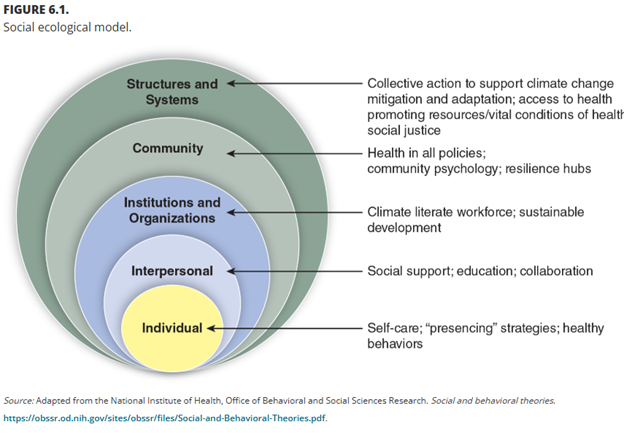
Chapter 6 in Case Studies in Environmental and Planetary Health explores how climate change disproportionately impacts marginalized communities. It emphasizes the need for intersectional, multifaceted approaches that center community voices, ensure equitable access to resources, and address social inequalities. The socioecological model (Figure 6.1) offers a clear framework for students to examine how individual, community, and societal factors interact to shape health outcomes.
Transform your teaching and make every lesson count with Case Studies in Environmental and Planetary Health.
This text builds real-world skills with 16 compelling case studies that help students tackle today’s pressing environmental health challenges. Grounded in core environmental competencies, this interdisciplinary text connects foundational science with practical application, preparing learners for collaborative, solution-focused roles in public health and environmental fields. Enhance learning with CourseConnect, an interactive platform included with your print purchase.

- Engaging Ways to Teach Kinsey’s Scale of Sexual Orientation - August 1, 2026
- Transform Your MSN Program with Complete Curriculum Solutions - February 26, 2026
- Lead the Future of Counseling with Comprehensive Curriculum Support - February 26, 2026