

Teaching quality improvement can feel abstract, especially when your students are learning remotely. But what if the principles of Kaizen—the Japanese philosophy of continuous improvement—could jump off the page and into your virtual classroom?
Interactive Learning, Real Results
Kaizen isn’t just a theory; it’s a cycle of real, incremental improvements. Remote teaching doesn’t have to limit your ability to make it tangible. Through interactive exercises, live polls, breakout discussions, and virtual process simulations, students can actively map workflows, identify inefficiencies, and propose solutions—mirroring real-world quality improvement cycles.
Engage, Apply, Repeat
Incorporating tools like case studies, team-based problem solving, and even gamified process challenges helps students practice Kaizen principles in a safe, virtual environment. They don’t just learn concepts, they test, adjust, and refine solutions in real time, experiencing firsthand how small changes lead to meaningful outcomes.
Quantitative Methods for Health Management, Chapter 5 introduces the Kaizen methodology and its four phases. Kaizen, a Japanese term meaning “continuous improvement,” was first developed by Toyota to enhance production efficiency. As a methodology, it provides a structured set of steps or tools to achieve ongoing improvements.
Kaizen emphasizes both processes and people, making it widely adopted in healthcare and other industries. Its continuous improvement cycle follows four phases—Plan, Do, Check, Act (PDCA)guiding organizations to identify opportunities for greater efficiency and effectiveness (see Figure 5.1).
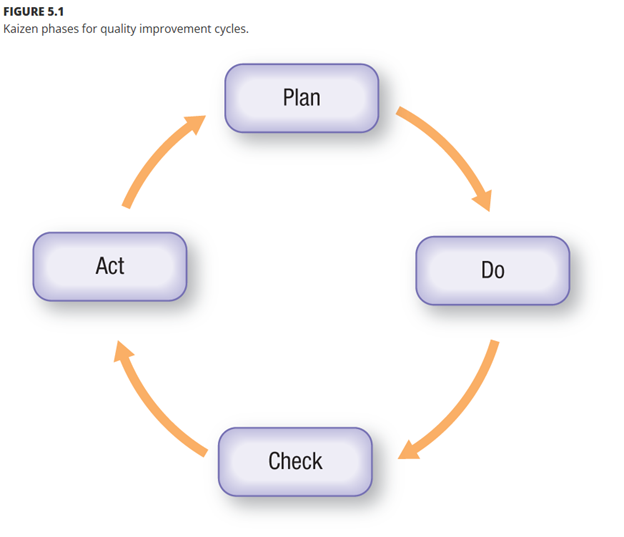
- Plan: In this phase, current state is investigated to identify problems and potential solutions.
- Do: This phase refers to a pilot implementation where selected solutions are tested in a controlled, small-scale environment.
- Check: Performance of the selected solutions is evaluated against expected outcomes.
- Act: In this phase, the final solution is implemented in full scale.
By embracing interactive remote teaching strategies, instructors can transform Kaizen from abstract philosophy into an engaging, hands-on experience. Your students won’t just understand continuous improvement—they’ll live it.
Pairing these interactive methods with a strong foundation, such as Quantitative Methods for Health Management, allows students to back their decisions with data-driven insights. Theory and practice merge seamlessly, ensuring graduates leave with the confidence and skills to lead quality improvement initiatives.
Help Your Students Turn Data into Action with Confidence
Quantitative Methods for Health Management, empowers your students to analyze trends, forecast demand, and lead data-driven healthcare strategies. Through hands-on case studies and real-world datasets, they build essential quantitative and software skills while applying key methodologies. Packed with practical tools, this text prepares students for careers in healthcare management, operations, analytics, and public health. With CourseConnect, they can actively know, use, and test their understanding on an interactive platform included with the print edition.

- Engaging Ways to Teach Kinsey’s Scale of Sexual Orientation - August 1, 2026
- Transform Your MSN Program with Complete Curriculum Solutions - February 26, 2026
- Lead the Future of Counseling with Comprehensive Curriculum Support - February 26, 2026