

Sexual orientation is a key concept in understanding LGBTQ+ identity and is defined as emotional, romantic, sexual, or affection-based attraction to others. As introduced in Multicultural Health, it reflects an innate aspect of sexuality and is one of the foundational elements influencing identity and community belonging (The Association of LGBTQ Journalists, 2021).
Early research by Alfred Kinsey (1948) shaped how we think about sexual orientation today. His seven-point continuum, ranging from exclusively heterosexual to exclusively homosexual (Figure 6.1), was one of the first attempts to move beyond a strict binary understanding and instead frame sexuality as a spectrum.
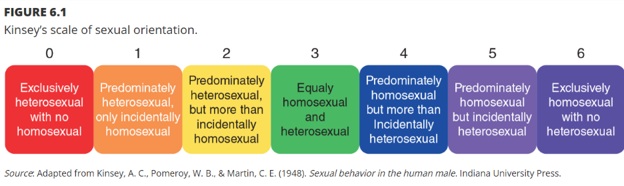
To teach this concept in an engaging way, begin with the Kinsey scale as an interactive classroom activity. Have students place hypothetical individuals along the continuum and explain their reasoning. This immediately encourages participation and challenges assumptions about fixed categories.
Then guide discussion with questions such as:
- What does a continuum help us understand about sexual orientation?
- What does it fail to capture?
- Where might identities such as bisexual, pansexual, queer, or asexual fit—or not fit?
- What does a linear model assume about identity?
Highlight that while Kinsey’s work was groundbreaking, it does not include many contemporary identities, such as pansexuality, which describes attraction to all sexes and genders. This helps students see both the historical importance and the limitations of early models.
Teaching focus: Use the Kinsey scale as an entry point to build foundational understanding, then guide students toward more inclusive, multidimensional views of sexual orientation.
This resource explores how social, cultural, and structural factors shape health disparities in the United States. Grounded in frameworks such as the social ecological model, cultural and structural competency, and intersectionality, it shows how identity, lived experience, and systemic inequities influence health outcomes especially in underserved and marginalized communities. It prepares students and professionals to deliver culturally responsive, equity-focused care in public health and healthcare settings.
Interactive Learning with CourseConnect
In addition to the rich resources available in the textbook, CourseConnect is included at no additional cost and enhances the student experience by providing questions and cases, quizzes, flashcards, and other opportunities to help students study, practice, and succeed.
Request Your Desk Copy to bring these concepts into your course.

- Engaging Ways to Teach Kinsey’s Scale of Sexual Orientation - August 1, 2026
- Transform Your MSN Program with Complete Curriculum Solutions - February 26, 2026
- Lead the Future of Counseling with Comprehensive Curriculum Support - February 26, 2026