
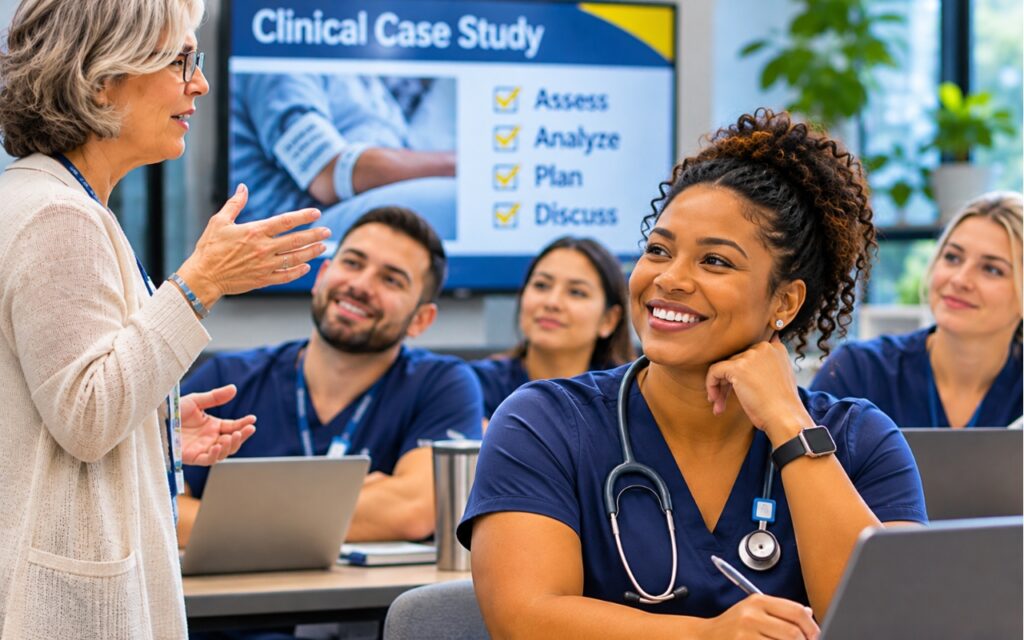
Graduate nursing students must do more than master complex clinical concepts. They need to evaluate evidence, develop clinical judgment, and apply their knowledge to patient care. For nursing faculty, the challenge is creating learning experiences that build those skills while keeping students engaged.
As National Nurse Practitioner Week, Nov. 8–14, recognizes the contributions of advanced practice nurses, nursing educators are sharing creative approaches to teaching the next generation of NPs.
From hands-on diagnostic exercises to personalized video feedback, nursing educators are using approaches that graduate faculty can adopt to make coursework more interactive, relevant, and connected to professional practice.
Here are seven strategies to consider.
1. Turn Clinical Cases Into Interactive Investigations
Interactive case studies can help students move beyond memorization by requiring them to analyze clinical information and make decisions.
Taylor Swing, DNP, CPNP-PC, CNE, specialty director of pediatric primary care at the University of Maryland School of Nursing, developed an activity called Developmental Detective to strengthen pediatric nurse practitioner students’ developmental assessment and clinical reasoning skills.
Students watch videos of children ages 0 to 24 months, estimate their developmental ages, identify milestones and potential delays, formulate surveillance questions, and recommend interventions and anticipatory guidance.
Rather than memorizing isolated milestones, students must consider multiple aspects of development simultaneously, much as they would during a clinical assessment.
Swing presented the approach at a regional National Association of Pediatric Nurse Practitioners conference in September 2026.
In a voluntary post-activity survey of eight students, all respondents strongly agreed that the exercise improved their knowledge of developmental milestones and confidence in conducting developmental assessments.
Although the small survey reflects students’ perceptions rather than independently measured learning outcomes, the feedback suggests that video-based clinical investigations can make developmental assessment more approachable.
2. Make Clinical Reasoning Tangible
Developing a differential diagnosis requires students to consider multiple possibilities and refine their thinking as new patient information becomes available.
Swing makes that process visible through Candy Differential, an activity that uses candy to represent potential diagnoses.
Students begin with an assortment of similarly colored candies representing possible diagnoses based on an initial pediatric presentation.
As the case progresses, the instructor introduces additional history, physical examination findings, and diagnostic results. Students eliminate candies representing less likely diagnoses until one remains.
The exercise illustrates how clinical reasoning evolves as evidence accumulates.
According to Swing, students appreciated the hands-on format because it made developing differential diagnoses easier to understand.
For faculty, the activity demonstrates how simple classroom materials can turn an abstract clinical concept into an interactive learning experience.
3. Use Formative Assessments to Identify Learning Gaps
Practice questions and self-assessments can help students recognize weaknesses before those gaps affect their performance.
Danielle Schaaf, DNP, APRN, FNP-C, a family nurse practitioner program professor at Nightingale College, emphasizes reviewing the reasoning behind correct and incorrect answers rather than simply completing more practice questions.
Although Schaaf’s recommendations focus on NP certification preparation, the principles can also inform formative assessments in graduate nursing courses.
Faculty can encourage students to examine why an answer is appropriate, identify weaknesses in foundational knowledge, and keep a record of concepts that need additional review.
Periodic assessments can also help students revisit challenging material and evaluate their understanding over time.
This approach reinforces clinical reasoning while helping students focus on areas that need more practice.
4. Make Online Feedback Personal
Asynchronous learning offers flexibility, but students may struggle to feel connected to instructors and classmates.
Sarah Morisette-Moore, DNP, MSN, MBA, RN, a professor at American Sentinel College of Nursing and Healthcare Sciences at Post University, addresses that challenge through personalized video feedback.
Instead of relying exclusively on written responses, she records brief, one- to two-minute videos responding to students’ discussion board contributions.
She also incorporates captioned multimedia resources and video demonstrations when concepts benefit from visual or spoken explanations.
Morisette-Moore says students frequently report that these interactions help them feel supported, valued, and connected to the learning environment.
The strategy provides a practical way to make asynchronous instruction more personal without requiring additional live sessions.
5. Connect Assignments to Real-World Nursing Responsibilities
Graduate nursing students are preparing for specialized professional roles, making the relevance of coursework especially important.
Morisette-Moore and her colleagues develop assignments aligned with students’ specialty tracks and anticipated workplace responsibilities.
For example, students pursuing nursing education study accreditation standards, expectations, and the roles of nursing-specific accrediting organizations.
The coursework introduces responsibilities they may encounter as nurse educators rather than treating accreditation as an abstract administrative topic.
According to Morisette-Moore, students consistently provide positive feedback about courses that reflect their professional experiences and future responsibilities.
For faculty, the lesson is to design assignments that connect academic concepts with situations students are likely to encounter in their chosen specialties.
6. Let Students Become the Teachers
Giving students opportunities to explain and demonstrate what they have learned can make them more active participants in the educational process.
Vanessa Ruiz, ND, RN, founder and program director of Nurses for Natural Health, uses peer teach-back in her continuing nursing education programs.
In her Therapeutic Yoga Certificate program, each participating nurse leads a 20- to 30-minute therapeutic session and receives feedback from peers and the instructor.
Ruiz says participants report that leading a session, rather than observing one, helps build confidence in applying the techniques with patients.
Although her program serves continuing nursing education rather than graduate degree students, the approach offers a model graduate faculty can adapt.
Students could lead case discussions, demonstrate clinical techniques, or explain evidence-based recommendations to classmates.
The emphasis shifts from receiving information to demonstrating and communicating understanding.
7. Flip the Classroom to Prioritize Application
Flipped learning moves introductory material outside the classroom, letting instructors spend more time on discussion, problem-solving, and hands-on practice.
Ruiz uses short preparatory videos that nurses watch before participating in live instruction.
For nurses at NYU Langone, she developed an AI-generated video demonstrating acupressure point locations that learners could review before and after hands-on training.
The video serves as a reference resource, while live instruction focuses on applying the material.
Ruiz also incorporates discussion of research limitations and potential risks into her courses, encouraging learners to evaluate interventions rather than accept them without question.
For graduate nursing faculty, the approach illustrates how technology can support preparation while preserving opportunities for hands-on practice and critical thinking.
Making Graduate Nursing Education More Engaging
Engaging graduate nursing students does not necessarily require expensive technology or a complete course redesign. From using candy to illustrate differential diagnoses to recording personalized feedback videos, these strategies demonstrate how creative approaches can encourage active participation and clinical reasoning.
For faculty preparing the next generation of advanced practice nurses, educators and clinical leaders, the goal is to create learning experiences that help students develop the judgment and confidence their future roles demand.

- AI in Nursing Education: How Faculty Can Embrace Technology Without Sacrificing Critical Thinking - November 13, 2026
- 7 Ways Nursing Faculty Can Make Graduate-Level Courses More Engaging - November 11, 2026
- Activate CourseConnect for a Chance to Win an iPad - September 22, 2026