
Want to give your students a hands-on way to understand how society shapes health? Assign a project on the social production of health disparities. This approach helps students see that differences in health outcomes aren’t just “bad luck” or individual choices—they are rooted in social, economic, and political structures.
How it works:
- Choose a Population or Community – Students pick a group to study, such as low-income neighborhoods, racial/ethnic minorities, or rural populations.
- Identify Social Determinants – Guide them to examine factors like housing, education, employment, environmental exposures, and access to care.
- Analyze Health Outcomes – Have students connect these social factors to differences in disease prevalence, mortality, or access to health care.
- Propose Solutions – Encourage ideas for policy, community programs, or interventions that could reduce disparities.
Why it works:
- Promotes critical thinking about systemic inequities.
- Connects social theory to real-world health outcomes.
- Prepares students to be advocates for change in public health and social policy.
This assignment transforms abstract concepts into actionable insights, helping students understand that health disparities are produced by society—and that society can also be part of the solution.
In Health Care Politics, Policy, and Services, chapter 6 gives your students a clear, compelling framework to explore how social factors produce health disparities, helping them connect theory to real-world outcomes.
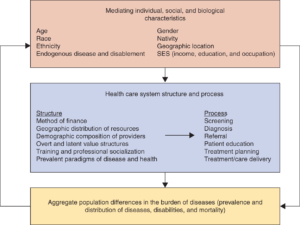
Figure 6.2 shows how health disparities—differences in disease burden—are linked to social characteristics in two ways.
Direct effects: Traits like age, gender, and ethnicity influence disease risk. For example, “race” reflects social and biological factors rather than purely biology.
Indirect effects: Social characteristics also affect health through the health care system. Discrimination against minorities, for instance, can increase disease burden.
Figure 6.2
A heuristic model of health disparity generation.
Take Your Syllabus to the Next Level
In Health Care Politics, Policy, and Services, dive into the U.S. health care system—its history, how care is delivered, and who it serves. Explore health inequities, social determinants, and key justice perspectives, from Rawls to Black feminist thought. See theory in action with COVID-19 and reproductive health debates—and test your knowledge with CourseConnect, the interactive learning platform included with your print copy.

- Engaging Ways to Teach Kinsey’s Scale of Sexual Orientation - August 1, 2026
- Transform Your MSN Program with Complete Curriculum Solutions - February 26, 2026
- Lead the Future of Counseling with Comprehensive Curriculum Support - February 26, 2026