
Discussions about gender bias in employment are essential—but they resonate most when students can actively engage with the topic rather than simply absorb information. Here are a few ways to make this content more interactive and meaningful in your course:
- Start with a reflective prompt.
Ask students to write or discuss an early experience—real or observed—where gender seemed to influence workplace roles, expectations, or outcomes. Reflection helps students connect abstract concepts to lived experience. - Use data-driven analysis.
Bring in current employment statistics on pay gaps, leadership representation, or occupational segregation. Have students interpret the data and explore what structural or cultural factors might explain the patterns. - Incorporate role-play or case studies.
Assign scenarios involving hiring decisions, promotion evaluations, or performance reviews. Ask students to identify moments where implicit bias could shape outcomes and to propose strategies for fairer practices. - Connect theory to policy.
Encourage students to examine organizational policies—such as parental leave, flexible work, or mentorship programs—and assess how these support or hinder gender equity. - End with actionable solutions.
Have students develop a brief policy recommendation or workplace training outline. Focusing on solutions empowers them to see how knowledge can translate into change.
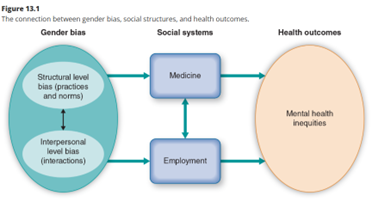
Chapter 13 in Mental Health Equity, highlights the impact of gender bias on women’s mental health. Women, particularly racial and ethnic minorities, are more likely than men to experience psychological distress and depression, partly due to anticipation of prejudice and systemic inequalities. Employment and education can help reduce some of these mental health disparities.
Figure 13.1 illustrates how gender bias interacts with social systems to influence mental and physical health, showing the pathways through which societal structures shape individual well-being.
By making the topic of gender bias in employment interactive, instructors can transform a challenging subject into a dynamic learning experience—one that builds critical awareness and inspires students to imagine more equitable workplaces.
Ready to take your syllabus to next level?
Mental Health Equity, Anchored in social justice and guided by evidence-based research, this pioneering text provides students in public health, mental health, health policy, social work, and related fields with the knowledge and tools to identify and address the root causes of inequity. Using a holistic, ecological approach, learners examine real-world strategies, policies, and programs that are reshaping the mental health system, while developing the skills to drive meaningful change for underserved communities.
Enhance your learning and test your understanding with CourseConnect, the interactive platform included with your print purchase.

- Engaging Ways to Teach Kinsey’s Scale of Sexual Orientation - August 1, 2026
- Transform Your MSN Program with Complete Curriculum Solutions - February 26, 2026
- Lead the Future of Counseling with Comprehensive Curriculum Support - February 26, 2026